Last Updated: May 2026 · Editorial Policy → · By MoneyKH Research Team →
💡 MONEYKH INDEPENDENCE PLEDGE: Independent research. No affiliate partnerships. AD-FUNDED · NOT AFFILIATE Full Disclaimer →
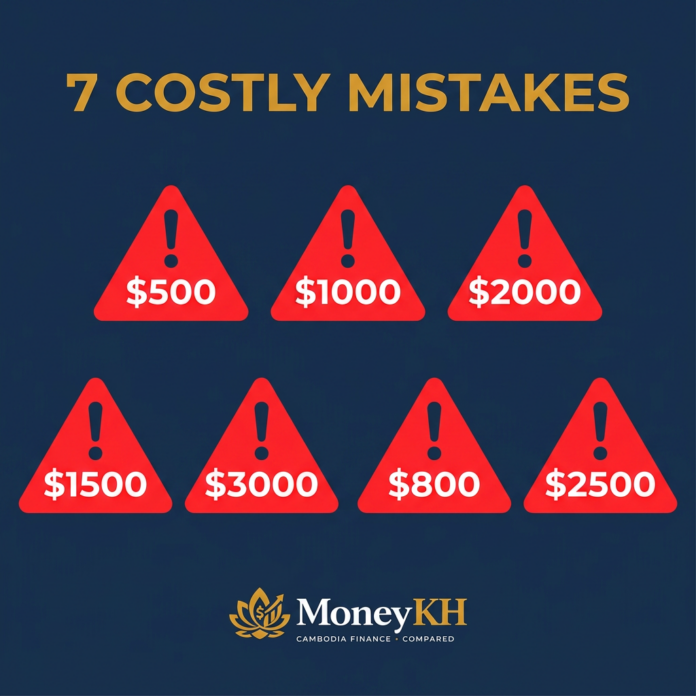
Most Cambodians and expats make at least 3 of these 7 financial mistakes without realising it — and each one costs real money. Cambodia’s financial landscape is unique: a dollarised economy, one of the world’s lowest deposit insurance limits, mobile-first banking, a gold-as-savings culture, and MFI loan rates that can trap borrowers at 18% annually. This guide identifies the 7 most common and costly financial mistakes in Cambodia in 2026, explains why each one happens, quantifies the real cost, and gives you the MoneyKH-verified fix. Whether you’re a Cambodian local, a returning EPS worker, a new expat, or an established resident — at least one of these applies to you. Share this article with anyone you care about in Cambodia. It may save them thousands of dollars.
🇰🇭 FINANCIAL LITERACY · COMMON MISTAKES · CAMBODIA MONEY GUIDE · 2026
Cambodia Financial Literacy 2026: 7 Costly Mistakes — and How to Fix Each One
Seven financial mistakes. Real dollar costs. MoneyKH-verified fixes. Share this with everyone you know in Cambodia.
7 Mistakes Covered:
- Mistake #1: Wrong savings account
- Mistake #2: All eggs in one bank
- Mistake #3: MFI loans over bank loans
- Mistake #4: Gold savings without understanding costs
- Mistake #5: Wallet balances instead of savings
- Mistake #6: Airport money exchange
- Mistake #7: No health insurance
$1,800
Annual cost of wrong savings account — lost interest vs best-rate ABA/Canadia FD on $30,000 savings.
$7,500
CDGC protection limit per bank. Deposits above this at one bank are unprotected if the bank fails.
18%
MFI loan rate cap. On a $5,000 MFI loan vs 10% bank loan: $400 extra interest per year.
8%
Gold jewellery spread/markup over gold investment price — the hidden cost most buyers don’t see.
$8,000
Cost of medical evacuation to Bangkok without health insurance. Mistake #7 can be catastrophic.
Mistake #1: Keeping Savings in a Low-Rate Account (or Cash)
❌ What Most People Do
Keep savings as cash at home, in a low-rate PSP wallet like Wing or TrueMoney (0–1% interest), or in a basic savings account earning 2–3% when better options exist.
✅ MoneyKH Fix
Open ABA Bank (4.5–5.0% savings rate) or place a Canadia Bank 24-month fixed deposit at 6.5% p.a. On $10,000, difference between 0% (cash) and 6.5% FD = $650/year earned vs nothing.
Mistake #2: All Savings in One Bank Above $7,500
❌ The Risk
Cambodia’s CDGC only insures $7,500 per bank. $50,000 in one bank = $42,500 is unprotected if that bank fails. This is a real risk — multiple Cambodian banks have failed in recent decades.
✅ MoneyKH Fix
Spread savings across NBC-licensed commercial banks: $7,500 max per bank for full CDGC coverage. ABA + Canadia + ACLEDA gives $22,500 in protected deposits across three tier-1 banks.
Mistake #3: Borrowing from MFIs When Bank Loans Are Available
❌ The Cost
MFI loans cost 14–18% p.a. vs commercial bank personal loans at 8–12% p.a. On a $10,000 loan over 3 years, choosing an MFI over ABA costs $1,200–$1,800 in extra interest.
✅ MoneyKH Fix
Always check ABA, ACLEDA, and Hattha Bank for personal or SME loans first. MFIs are for borrowers who genuinely cannot access commercial bank credit — if you can qualify for a bank loan, you should always take it.
Mistake #4: Treating Gold Jewellery as an Investment
❌ The Hidden Cost
Jewellery gold includes a workmanship and retail markup of 8–20% above gold’s investment price. When you sell, that premium disappears — you receive only the melt value. A $2,000 jewellery purchase may sell for $1,700 the next day.
✅ MoneyKH Fix
Buy investment-grade gold (bars or official Chi units from JOX Gold or Olympic Gold) if you want gold as savings. The spread is far narrower. Gold as jewellery is for wearing — not for saving.
Mistake #5: Keeping Significant Money in PSP Wallets (Not Banks)
❌ The Risk
TrueMoney, Pi Pay, and similar PSP wallets are not CDGC-protected. If the company fails, your wallet balance is not guaranteed by any insurance scheme. They are payment tools — not savings accounts.
✅ MoneyKH Fix
Keep only spending money in PSP wallets — no more than $200–$500 in any single wallet. Move everything above your monthly spending needs into an ABA savings account where it earns 4.5–5% and is CDGC-protected.
Mistake #6: Using Airport or Street Exchange for Large Amounts
❌ The Cost
Airport exchange spreads run 5–8% worse than banking channels. On $10,000 exchanged at the airport vs an ABA forex counter, the difference is $500–$800 — enough for a month’s rent in Chbar Ampov.
✅ MoneyKH Fix
Use ABA Bank, Wing Bank, or Wise for currency exchange. Always exchange the minimum possible at airports — only what you need for transport. Exchange the bulk through banking channels where spreads are 1–2%.
Mistake #7: Living in Cambodia Without Health Insurance
❌ The Catastrophic Risk
Medical evacuation to Bangkok costs $5,000–$10,000 without insurance. A serious accident at a private Phnom Penh hospital can cost $2,000–$10,000+. One medical emergency can wipe out years of savings.
✅ MoneyKH Fix
Pacific Cross or AIA mid-tier plans with evacuation coverage cost $80–$200/month for under-40s. This is the lowest-cost, highest-return financial product available to any expat in Cambodia. Non-negotiable.
FAQ: Cambodia Financial Literacy 2026
Q: What is the biggest financial mistake Cambodians make with their savings?
The most costly mistake is keeping savings as cash at home or in low-rate accounts when ABA Bank offers 4.5 to 5 percent savings rates and Canadia Bank offers 6.5 percent on 24-month fixed deposits. On $10,000 in savings, the difference between zero interest and 6.5 percent is $650 per year — money earned passively without any risk.
Q: How much of my savings is protected if a Cambodian bank fails?
The Cambodia Deposit Guarantee Corporation (CDGC) protects up to approximately $7,500 USD per depositor per NBC-licensed bank. If you have more than $7,500 in savings, spread it across multiple NBC-licensed commercial banks — ABA, Canadia, and ACLEDA are all tier-1 options. Each gives you $7,500 in separate CDGC protection.
Q: Should I borrow from an MFI or a commercial bank?
Always try a commercial bank first. ABA, ACLEDA, and Hattha Bank offer personal and SME loans at 8 to 12 percent per annum — significantly lower than the NBC-mandated MFI cap of 18 percent. MFIs serve borrowers who genuinely cannot access commercial banking credit. If you qualify for a commercial bank loan, you should always take it over an MFI loan.
Q: Is gold a good way to save money in Cambodia?
Investment-grade gold (bars or Chi units from JOX Gold or Olympic Gold) can be a reasonable savings vehicle for Cambodians who prefer physical assets. However, gold jewellery includes a 8 to 20 percent workmanship premium that disappears on resale — jewellery is not the same as investment gold. For most people, a 6 percent fixed deposit is a better risk-adjusted savings option than gold.
Q: Are TrueMoney and Wing wallet balances protected like bank deposits?
No. TrueMoney, Wing (wallet balance above the banking product), Pi Pay, and other PSP wallets are not CDGC-protected. They are NBC-regulated but under a different framework that does not include deposit insurance. Keep only spending money in wallets — transfer anything above your monthly budget into an ABA savings account where it earns interest and is protected.
Q: What is the best bank account for savings in Cambodia 2026?
For daily savings with full flexibility, ABA Bank offers 4.5 to 5 percent on USD savings accounts with Cambodia’s best mobile app. For maximising returns on fixed savings, Canadia Bank’s 24-month fixed deposit at 6.5 percent is the market leader. MoneyKH recommends using ABA for liquidity and Canadia for lump-sum long-term savings.
Q: Why is health insurance essential in Cambodia?
Medical evacuation to Bangkok for serious conditions costs $5,000 to $10,000 without insurance. Cambodia’s public healthcare system is not adequate for serious medical needs. Private hospitals in Phnom Penh handle routine care well but refer serious cases to Bangkok. A Pacific Cross or AIA mid-tier plan with evacuation coverage costs $80 to $200 per month — one of the best value financial products available.
Q: How much do I lose by exchanging money at Phnom Penh Airport?
Airport exchange counters in Phnom Penh typically offer exchange rates 5 to 8 percent worse than banking channels. On $10,000 exchanged at the airport versus at an ABA Bank forex counter, you lose $500 to $800 immediately. Always exchange only the minimum needed for transport at the airport, then use a bank for the rest.
Q: What is the biggest risk for expats with savings in Cambodia?
The two biggest risks for expats are: deposits above the $7,500 CDGC limit in a single bank (unprotected if that bank fails), and living without health insurance (one medical emergency can cost more than a year of savings). Both are fixable in under one hour — spread deposits across multiple banks and get health insurance this week.
Q: Is Cambodia’s banking system safe enough to trust with significant savings?
Yes, with the right structure. NBC-licensed commercial banks — ABA, ACLEDA, Canadia — are well-regulated, regularly audited, and have strong parent company backing. ABA’s parent is the National Bank of Canada. Canadia Bank is majority Cambodian-owned with deep capital reserves. The risk of bank failure at the tier-1 level is low, but CDGC protection limits mean diversification across banks is still the prudent approach for significant savings.
MoneyKH — Cambodia Financial Literacy 2026
Which of these 7 mistakes are you making?
The good news: every single one of these mistakes is fixable in under a day. Open ABA. Split your savings. Get health insurance. Convert at a bank. These decisions cost nothing to fix and could save you thousands.
Share This Guide — It May Save Someone Thousands
Subscribe to MoneyKH for weekly Cambodia banking updates, rate changes, and financial literacy guides.
More MoneyKH: Cambodia Finance Essentials
- Best Banks in Cambodia 2026 →
- Fixed Deposit Rates 2026 →
- Is My Money Safe in a Cambodian Bank? →
- Best Health Insurance in Cambodia 2026 →
- Cambodia Fintech Landscape 2026 →
Published by MoneyKH Research Team. May 2026. No financial advice. Full disclaimer →
The MoneyKH Research Team comprises independent financial researchers, market analysts, and editorial professionals with direct on-ground knowledge of Cambodia’s banking, fintech, and financial services sector. All rates, fees, and product data published on MoneyKH are verified directly with each institution before publication. MoneyKH operates as an editorially independent platform with no affiliate partnerships — see our editorial policy for full disclosure.