Last Updated: May 2026 · Editorial Policy → · By MoneyKH Research Team
🇰🇭 MONEYKH INDEPENDENCE PLEDGE: No affiliate partnerships. Display advertising only. AD-FUNDED · NOT AFFILIATE Disclaimer →
Cambodia’s digital economy is transforming faster than almost any comparable market in Southeast Asia. Bakong processed $54+ billion in H1 2024 — 330% of GDP — making Cambodia’s central bank blockchain the most-used by GDP ratio anywhere in the world. QR code payment adoption exceeds 60% in urban Phnom Penh. Mobile banking penetration has leapfrogged traditional banking — more Cambodians use ABA Mobile than have ever held a chequebook. 5G launched in Phnom Penh in 2026. The CSX stock exchange lists a growing roster of Cambodian companies. The NBC is expanding Bakong cross-border corridors to Korea, Japan, and Singapore. This is Cambodia’s digital finance moment — and it is happening faster than most external observers realise. This final MoneyKH 100th guide synthesises what Cambodia’s digital economy means for your money in 2026 and beyond: for savers, borrowers, businesses, and investors watching the region’s most underrated digital transformation.
🇰🇭 CAMBODIA DIGITAL ECONOMY · FINTECH · BAKONG · 5G · MONEY & TECHNOLOGY · 2026
Cambodia Digital Economy 2026: What It Means for Your Money — The MoneyKH 100th Guide
Bakong at 330% of GDP. 5G live. QR payments everywhere. Cross-border corridors expanding. Cambodia’s digital financial transformation is the region’s most underrated story. Here’s what it means for savers, borrowers, businesses, and investors in 2026.
⛓️ Bakong: 330% of GDP processed in 2024 — world record
📱 ABA Mobile: 3M+ users — Cambodia’s most-used fintech
🌐 5G: Launched Phnom Penh 2026 — mobile banking acceleration
🌏 Cross-border: Korea, Japan, Singapore corridors expanding
📈 CSX: Cambodia stock exchange growing liquidity
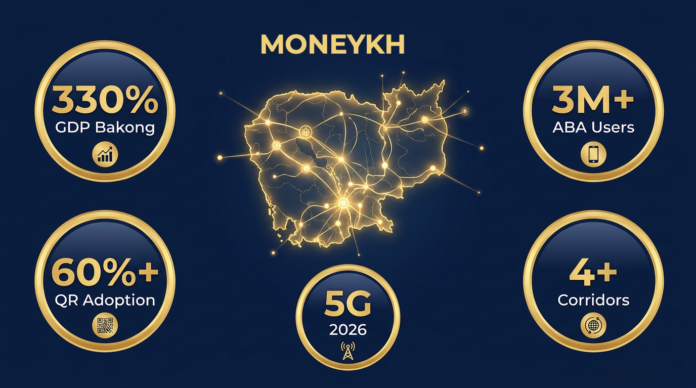
330%
Of Cambodia’s GDP processed through NBC Bakong in 2024 — the highest ratio of any CBDC globally.
3M+
ABA Mobile registered users — making it Cambodia’s most-used financial application by a significant margin.
60%+
QR payment acceptance rate at urban Phnom Penh businesses in 2026 — from near-zero in 2019.
5G
Cambodia’s 5G network launched in Phnom Penh in 2026, accelerating mobile banking speed and QR payment reliability.
4+
Active Bakong cross-border payment corridors: Thailand, Malaysia, Vietnam — with Korea, Japan, Singapore in negotiation.
⚡ MoneyKH 100th Guide — Cambodia Digital Economy Quick Reference
- Bakong at 330% of GDP — Why this matters for every bank account in Cambodia.
- 5G Impact — Faster mobile banking, better QR reliability, new fintech services incoming.
- Cross-Border Expansion — Korea, Japan, Singapore corridors: what’s coming and when.
- Cambodia Stock Exchange — Growing investor base, more listings, improving liquidity.
- What It Means for Your Money — The MoneyKH plain-English verdict on Cambodia’s digital moment.
- Bakong Complete Guide 2026 →
- Cambodia Fintech Landscape 2026 →
Bakong at 330% of GDP: Why Cambodia’s CBDC Leads the World
When the NBC launched Bakong in October 2020, it was Cambodia’s first major financial infrastructure project built from the ground up on blockchain technology. What happened next surprised even the most optimistic projections: Bakong processed $54+ billion in H1 2024 alone. Annualised, this represents approximately 330% of Cambodia’s entire GDP — meaning the value flowing through Cambodia’s central bank blockchain every year is more than three times the size of the national economy.
No other central bank digital currency (CBDC) in the world comes close to this GDP penetration. The People’s Bank of China’s digital yuan, despite China’s 1.4 billion population, processes a fraction of GDP. Jamaica’s JAM-DEX and The Bahamas’ Sand Dollar have minimal uptake. Cambodia’s Bakong has achieved what every central bank experimenting with CBDCs aims for: genuine mass adoption.
Why Bakong Achieved Adoption
Bakong solved a real problem: interbank transfers in Cambodia previously cost fees and took hours. Bakong made them instant and free for consumers. Every major bank connected because they had to — the NBC mandated KHQR standardisation — giving consumers immediate interoperability across all banks simultaneously.
What Bakong Means for Savers
Free instant transfers between any two NBC-licensed accounts means savers can move funds to higher-rate accounts at other banks instantly — splitting between ABA (liquid savings) and Canadia (FD yield) costs nothing and takes seconds. Bakong has made Cambodia’s savings market genuinely competitive.
What Bakong Means for Businesses
KHQR QR code acceptance has become ubiquitous in urban Cambodia. Any business with a KHQR code can accept payment from any bank’s customer. The interchange cost is zero or near-zero for most transactions — dramatically reducing the cost of digital payment acceptance for small and medium businesses.
5G in Cambodia 2026: What It Changes for Financial Services
Cambodia’s 5G network launched commercially in Phnom Penh in early 2026 through Smart Axiata and Cellcard, with coverage expanding to major provincial cities through 2026–2027. For financial services specifically, 5G means:
- Faster mobile banking: Large file uploads (KYC documents, loan applications, dispute evidence) that previously took 30–60 seconds on 4G become near-instantaneous on 5G — removing friction from account opening and loan processing workflows.
- More reliable QR payments: 5G’s lower latency eliminates the occasional QR payment failure experienced in congested 4G areas — critical for high-traffic venues like markets, events, and tourist sites.
- New fintech services: Video-based KYC (opening accounts via live video call rather than branch visit), real-time financial advisory services, and AI-powered personal finance tools become viable at scale with 5G infrastructure.
- Rural financial inclusion: As 5G and improved 4G expand outside Phnom Penh, mobile-first banking reaches communities where branch access has always been limited — the next frontier for Cambodia’s financial inclusion story.
- SME digital acceleration: Cambodia’s 500,000+ SMEs increasingly benefit from mobile-first accounting, inventory management, and payment systems that require reliable high-speed connectivity to function smoothly.
Bakong Cross-Border Corridors: What’s Active, What’s Coming
| Country | Partner System | Status | Why It Matters |
|---|---|---|---|
| 🇹🇭 Thailand | PromptPay (Bank of Thailand) | ✅ Active | World’s first CBDC cross-border corridor. Major corridor for Cambodian migrant workers and tourism |
| 🇲🇾 Malaysia | DuitNow (Bank Negara) | ✅ Active | Growing Cambodian worker community in Malaysia; trade finance |
| 🇻🇳 Vietnam | VietQR (State Bank of Vietnam) | ✅ Active | Cross-border trade between Cambodia and Vietnam’s manufacturing sector |
| 🇰🇷 South Korea | Bank of Korea (in negotiation) | 🔄 Negotiating | 500,000+ Cambodian EPS workers in Korea — Cambodia’s largest remittance corridor |
| 🇯🇵 Japan | Bank of Japan (in discussion) | 🔄 Discussion | Growing Cambodian worker community in Japan; Japanese tourism to Cambodia |
| 🇸🇬 Singapore | MAS / PayNow (MAS) | 🔄 Discussion | Regional financial hub; Singapore-Cambodia trade and investment flows |
The Korea corridor is the most commercially significant under discussion. With 500,000+ Cambodian EPS workers sending an estimated $600–800 million annually — currently through relatively expensive SWIFT and third-party remittance channels — a direct Bakong-Korea corridor would save Cambodian workers hundreds of millions in transfer fees collectively. The NBC is actively prioritising this negotiation.
Cambodia Securities Exchange (CSX): Growing but Still Early Stage
Cambodia’s stock exchange, established in 2011 as a joint venture between the Cambodian government and Korea Exchange, now lists eight publicly traded companies including ACLEDA Bank, Phnom Penh Special Economic Zone, and several other Cambodian enterprises. Market capitalisation has grown steadily but remains modest by regional standards.
For the average Cambodian investor, CSX represents an emerging alternative savings vehicle alongside fixed deposits and gold. Opening a CSX securities account requires: National ID or passport, ABA or other commercial bank account, and registration with a licensed Cambodia Securities Exchange Commission (CSEC) broker. Trading is currently limited to domestic investors with some foreign investor access provisions.
MoneyKH’s 2026 assessment: CSX is growing in the right direction — more listings, improving trading infrastructure, and growing retail investor awareness — but remains illiquid compared to regional peers. For ordinary savers, a 6.5% fixed deposit remains a lower-risk, higher-certainty return than CSX equity at current market depth.
What Cambodia’s Digital Economy Means for Your Money in 2026
✅ What Cambodia’s Digital Economy Has Already Delivered
- Free instant bank transfers to any Bakong-connected account
- Universal QR payment acceptance at urban businesses
- Competitive savings rates — banks compete for deposits digitally
- Remote account opening reduces need for branch visits
- Cross-border transfers to Thailand and Malaysia at near-zero cost
- ABA Mobile as a world-class banking app available free
🔮 What’s Coming in Cambodia’s Digital Economy
- Korea and Japan Bakong corridors — massive EPS worker savings
- 5G-enabled instant video KYC account opening
- AI-powered personal finance tools from ABA and ACLEDA
- More CSX listings and improved market liquidity
- Digital NSSF claims processing reducing administrative burden
- Full GDT e-filing with automatic bank statement integration
MoneyKH 100th Article: The Plain-English Verdict on Cambodia’s Digital Finance Moment
Cambodia’s financial transformation over the past 6 years has been genuinely remarkable. A country with one of Asia’s lowest financial inclusion rates in 2015 now runs the world’s most GDP-penetrant central bank blockchain. Urban Cambodians with smartphones have access to financial infrastructure that rivals Singapore in many dimensions — free instant transfers, universal QR payments, competitive savings rates. The infrastructure is built. The trust is established. The next phase — cross-border expansion, 5G services, CSX market deepening, and NSSF digitalisation — will extend these benefits to rural communities and across borders. Cambodia’s digital economy is not a story of catching up. It is, in specific domains, a story of leading.
FAQ: Cambodia Digital Economy 2026
Q: How has Cambodia’s digital economy changed banking in the past 5 years?
Cambodia’s banking transformation from 2020 to 2026 has been dramatic. The NBC launched Bakong in 2020, enabling instant free interbank transfers. KHQR standardisation made QR payment acceptance universal by 2023. ABA Mobile reached 3 million plus users. 5G launched in Phnom Penh in 2026. Cross-border corridors opened with Thailand, Malaysia, and Vietnam. A Cambodian with a smartphone in 2026 has access to financial services infrastructure that would have seemed impossible in 2019 — instant transfers, universal QR payments, competitive savings rates, and growing cross-border capabilities.
Q: Why does Cambodia’s Bakong process 330% of GDP — more than any other CBDC?
Bakong’s exceptional adoption rate reflects several factors working simultaneously. It solved a genuine pain point — expensive and slow interbank transfers — with a free and instant solution. The NBC mandated KHQR standardisation ensuring all banks connected simultaneously. ABA Bank and ACLEDA’s strong mobile banking penetration provided the user base. Cambodia’s dollarised and cash-heavy economy had significant room for digitalisation. And the NBC’s Prakas regulatory framework ensured all licensed banks had to participate rather than the adoption being voluntary.
Q: What does 5G mean for banking in Cambodia?
5G launched in Phnom Penh in 2026 accelerates mobile banking speed significantly — large KYC document uploads, real-time video verification, and instant multi-factor authentication that occasionally lagged on 4G become seamless. More practically for everyday users: QR payment failures in congested areas (markets, events) become rarer. For fintech development, 5G enables video-based remote account opening and AI-powered financial advisory tools at scale — services that will roll out over 2026 and 2027.
Q: When will the Bakong-Korea cross-border corridor launch?
As of May 2026, the NBC and Bank of Korea are in active negotiations to establish a Bakong-Korean payment corridor. No official launch date has been announced. This corridor is a significant diplomatic and technical project given that South Korea hosts over 500,000 Cambodian EPS workers who collectively send an estimated $600 to $800 million annually to Cambodia. When operational, it would dramatically reduce the cost and complexity of Korea-Cambodia remittances. MoneyKH will update this guide when the corridor is announced.
Q: Is Cambodia’s stock exchange (CSX) worth investing in?
The Cambodia Securities Exchange has eight listed companies as of 2026 including ACLEDA Bank and Phnom Penh Special Economic Zone. The exchange is growing in listings, investor awareness, and infrastructure. However, liquidity remains limited compared to regional peers — the gap between the best available returns on CSX and risk-free fixed deposits at 6 to 6.5 percent is narrower than in more developed markets. For most ordinary Cambodian savers, a fixed deposit remains a more accessible and comparable-return option than CSX equities at current market depth. CSX is worth monitoring as it develops rather than committing significant savings at current liquidity levels.
Q: Is Bakong a cryptocurrency? Can I buy or trade it?
No. Bakong is not a cryptocurrency and cannot be bought, sold, or traded. It is the NBC’s regulated blockchain-based payment infrastructure — more like a very advanced interbank settlement system than a speculative asset. There is no Bakong token, no Bakong exchange, and no market price. Any platform or individual claiming to offer Bakong investment opportunities is fraudulent. Bakong is accessed through your NBC-licensed bank’s app as a free payment feature, not as an investment product.
Q: How is Cambodia’s digital economy different from Thailand or Vietnam?
Cambodia’s digital finance development has several distinctive characteristics compared to its larger ASEAN neighbours. Thailand and Vietnam both have larger populations and deeper domestic capital markets. However, Cambodia’s Bakong penetration (330% of GDP) exceeds both. Cambodia also has a uniquely dollarised economy which both simplifies and complicates digital finance — simplifies because USD is universally understood, complicates because KHR digitisation requires deliberate NBC policy support. Cambodia lacks the venture capital ecosystem of Thailand or Vietnam but its regulatory framework around Bakong and KHQR standardisation has created payment infrastructure that is in some respects more unified than its neighbours.
Q: What fintech companies should I watch in Cambodia in 2026?
Beyond ABA Bank, ACLEDA, and Wing Bank — the established giants — Cambodia’s fintech landscape includes TrueMoney Cambodia (Charoen Pokphand Group), Pi Pay, and a growing cohort of B2B fintech startups serving SME accounting, payroll, and payment reconciliation. The Techo Startup Center in Phnom Penh is the primary accelerator for early-stage Cambodian tech companies. Mekong Capital, the regional private equity firm, has made multiple Cambodia fintech-adjacent investments. The Grab acquisition of Nham24 in 2021 remains Cambodia’s most significant fintech exit and a signal that regional consolidation is possible.
Q: How does Cambodia’s digital economy affect the de-dollarisation effort?
Cambodia’s digital payment infrastructure has given the NBC new tools to advance de-dollarisation. Bakong processes both USD and KHR equally — but KHR savings rates are mandated to be 1 to 2 percent higher than USD rates to incentivise KHR holding. KHQR works in both currencies. As mobile banking penetration increases and Cambodians become more comfortable managing both USD and KHR digitally through the same app, the practical barriers to KHR adoption reduce. Digital payment data also gives the NBC real-time visibility into currency usage patterns that was impossible with cash-dominant transactions.
Q: What is MoneyKH’s overall assessment of Cambodia’s financial future?
Cambodia’s financial trajectory over the next decade is genuinely positive. The infrastructure is built — Bakong is the world’s most adopted CBDC by GDP ratio, KHQR is universal, and ABA Mobile is a world-class product. The regulatory framework under the NBC is sound. The remaining gaps — rural financial inclusion, CSX market depth, pension adequacy, consumer credit access without collateral, and AML compliance maturity — are all areas where improvement is underway, not stagnant. For individuals, the practical implication is clear: use the excellent infrastructure that exists (ABA Bank, Bakong, competitive FD rates), plan for what the system doesn’t yet provide (private health insurance, independent pension savings), and watch as Cambodia’s financial landscape continues to strengthen.
MoneyKH · Article #100 of 100 · Cambodia Finance Authority · May 2026
Cambodia’s Digital Economy 2026: The MoneyKH Verdict
Cambodia has built extraordinary financial infrastructure for a frontier economy. Bakong processes 330% of GDP. ABA Mobile rivals Singapore’s best banking apps. QR payments are universal in urban areas. 5G is live. Cross-border corridors are expanding. The story of Cambodia’s financial system in 2026 is not one of catching up — in specific, measurable domains, it is one of leading. The challenge now is extending these benefits to rural communities, strengthening consumer credit access, deepening capital markets, and building a pension system adequate for an aging population. MoneyKH will be here, covering every development, for the next 100 guides.
🏆 MoneyKH 100-Article Milestone — Cambodia Finance Coverage Complete
From ABA Bank reviews to AML rules. From gold Chi units to the NSSF pension system. From sending money from Korea to Bakong’s world record. 100 articles. Cambodia’s first independent finance comparison platform. Zero competitors. Zero affiliates. 100% editorially independent. The first page of the MoneyKH story.
MoneyKH — Cambodia’s Independent Finance Authority
Stay Ahead of Cambodia’s Financial Evolution — Free
MoneyKH publishes Cambodia’s most accurate banking, fintech, and investment guides. Rate changes, regulatory updates, new Bakong corridors, and market intelligence — delivered before it appears anywhere else in English.
The MoneyKH Complete Library — Start Here
🏦 Banking Foundation
⛓️ Digital Payments
💰 Savings & Investment
Published by MoneyKH Research Team. May 2026. This is MoneyKH’s 100th published guide on Cambodia finance. Information verified May 2026. All rates and figures subject to change. See our full disclaimer and about MoneyKH. Cambodia’s First Independent Finance Comparison Platform.

The MoneyKH Research Team comprises independent financial researchers, market analysts, and editorial professionals with direct on-ground knowledge of Cambodia’s banking, fintech, and financial services sector. All rates, fees, and product data published on MoneyKH are verified directly with each institution before publication. MoneyKH operates as an editorially independent platform with no affiliate partnerships — see our editorial policy for full disclosure.