Last Updated: May 2026 · Editorial Policy → · By MoneyKH Research Team →
🇰🇭 MONEYKH INDEPENDENCE PLEDGE: No affiliate partnerships. Display advertising only. AD-FUNDED · NOT AFFILIATE
Over 500,000 Cambodian workers are enrolled in South Korea’s Employment Permit System (EPS), making South Korea Cambodia’s single largest remittance corridor — sending an estimated $600–$800 million USD home annually. When these workers return to Cambodia after contracts of 3–5 years, they often carry Korean Won savings of KRW 20–80 million ($15,000–$60,000 USD equivalent) and face an immediate set of financial decisions: how to convert currency, where to deposit savings, whether to invest or start a business, and how to avoid losing 5–15% of their savings to poor exchange rates or bad decisions. This guide answers every financial question a returning EPS worker faces — from airport money exchange to ABA Bank account setup, Wing Bank remittance tools, fixed deposit rates, and the Cambodia SME loan options available to returning workers with capital.
🇰🇷→🇰🇭 RETURNING EPS WORKERS · KOREA REMITTANCE · SAVINGS GUIDE · CAMBODIA BANKING 2026
Banking for Cambodian Workers Returning from Korea 2026: What To Do With Your Savings
You worked 3–5 years in Korea. You saved KRW 20–80 million. Now you’re back in Cambodia. The next 30 days of financial decisions will define the next 10 years of your life. Here’s the MoneyKH complete guide.
💰 Average savings on return: $15,000–$60,000 USD
🏦 Best deposit account: ABA Bank fixed deposit (5.75–6.25% p.a.)
💱 Best KRW→USD rate: Wing Bank or ABA (avoid airport)
🏢 SME loan access: Available with Korea savings as collateral
⚠️ Biggest risk: Poor exchange rate + unplanned spending
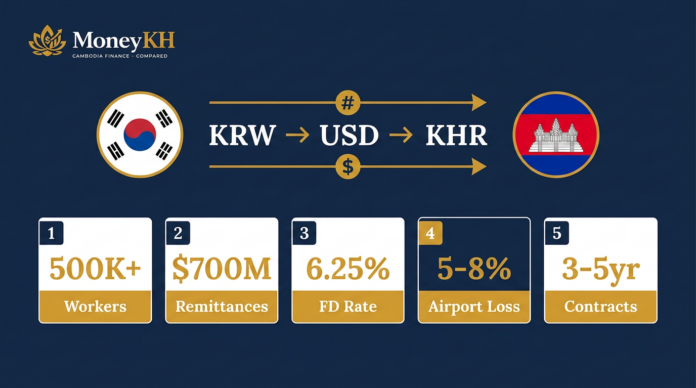
500K+
Cambodian workers enrolled in Korea’s EPS programme — the largest single migrant worker corridor from Cambodia.
$700M+
Estimated annual remittance from Korea to Cambodia — Cambodia’s largest single-country inbound corridor.
6.25%
Best 12-month USD fixed deposit rate in Cambodia (ABA / Canadia Bank) — best home for returning worker savings.
5–8%
Airport/informal KRW exchange rate loss vs banking channel. On $30,000, this costs $1,500–$2,400.
3–5 yrs
Typical EPS contract length. Workers return with significant savings but face immediate high-pressure financial decisions.
⚡ MoneyKH Quick Reference — Returning Korea Workers 2026
- Converting KRW to USD — Best rates, worst rates, and the airport trap to avoid.
- Fixed Deposit Rates — ABA vs Canadia vs ACLEDA for your lump sum savings.
- Starting a Business — SME loans, business registration, and what Korea savings qualify for.
- Send Money Korea to Cambodia 2026 → — Transfer methods compared.
- Cambodia Fixed Deposit Rates 2026 → — All banks compared.
- Cambodia SME Finance Guide 2026 → — For workers starting businesses.
Step 1: Converting Your Korean Won — Getting the Best Rate
The single most costly mistake returning EPS workers make is converting KRW at Phnom Penh International Airport or at informal roadside exchanges. The spread between the official rate and airport/street rates typically runs 5–8%, meaning on KRW 50 million ($37,000 USD), you lose $1,850–$2,960 before you’ve even deposited your savings.
KRW Conversion Options — Ranked Best to Worst
| Option | Rate Quality | On $30,000 | How To Use |
|---|---|---|---|
| Wire transfer from Korean bank → ABA Cambodia (before flying) | Best ⭐ | ~$30,000 | Wire from Korean bank to ABA USD account before returning. Funds arrive within 1–2 days. |
| Wing Bank remittance (KRW→USD) | Very Good | ~$29,700 | Wing Bank has Korea-Cambodia corridor deals. Send before or immediately after arrival. |
| ABA Bank forex counter (USD) | Good | ~$29,400 | Walk-in forex. Less competitive than wire but still far better than street. |
| Street/informal exchange | Poor ⚠️ | ~$28,200 | Avoid. Unregulated. Counterfeit risk. Rate 5–8% below banking channels. |
| Airport exchange counter | Worst ⚠️ | ~$27,600 | Worst rates in Cambodia. Only exchange absolute minimum needed for transport home. |
💡 MoneyKH Recommendation: Send Before You Fly
The best financial decision a returning EPS worker can make is to open an ABA Bank account in Cambodia before their last contract year (via the ABA Mobile app, usable internationally), then wire their Korean savings to their ABA USD account in the final week before returning. This locks in the bank wire rate — typically 1–2% better than the best walk-in option — and means funds are waiting and earning upon arrival.
Step 2: Where to Deposit Your Korea Savings in Cambodia
Once your KRW is converted to USD, the next decision is where to hold it. For returning EPS workers with $15,000–$60,000 in savings, the right structure is a combination of a liquid savings account for short-term needs and a fixed deposit for the bulk of the savings to maximise interest income.
| Bank | Savings Rate | 12m FD Rate | 24m FD Rate | Best For |
|---|---|---|---|---|
| ABA Bank ⭐ | 4.5–5.0% | 5.75–6.25% | 6.00% | Best app, Bakong access, SWIFT, full banking |
| Canadia Bank | 4.0–4.75% | 6.00–6.25% | 6.50% | Highest 24-month FD rate. Best for long-term savers. |
| ACLEDA Bank | 3.5–4.5% | 5.50–6.00% | 5.75% | Rural branch access. Good for workers returning to provinces. |
💰 MoneyKH EPS Worker Savings Strategy (on $30,000 return savings)
- $5,000 → ABA savings account — 3–6 months living expenses, fully liquid, Bakong-enabled for daily transactions
- $15,000 → ABA 12-month fixed deposit at 6.25% — earns $937.50 over 12 months, accessible after 12 months for business or further investment
- $10,000 → Canadia Bank 24-month FD at 6.50% — earns $1,300 over 24 months, long-term wealth building
- Total interest earned in Year 1: approximately $1,400–$1,600 on $30,000 savings — roughly one month’s EPS salary in Korea, earned passively
Step 3: Investment Options for Returning EPS Workers
🏦 Fixed Deposits (Lowest Risk)
ABA or Canadia FDs at 6–6.5% p.a. Risk-free. CDGC-protected to $7,500. Best for workers who want certainty before deciding on a business. Spread across two banks if above $7,500 per institution.
🏢 SME / Small Business (Medium Risk)
Use Korea savings as startup capital. ACLEDA and ABA offer SME loans for businesses with collateral. Korea savings can also act as collateral for an SME loan — leverage $20,000 into $40,000+ in business capital.
🏠 Property (Higher Risk/Higher Reward)
Land and property remain the most common investment for returning EPS workers. Requires legal advice — foreigners cannot own land. Cambodian returnees can. Use ABA Home Loan to leverage savings as down payment for property purchase.
Starting a Business with Your Korea Savings
Returning EPS workers are among the most business-ready demographic in Cambodia — they have capital, work experience, and often technical skills acquired in Korea. The most common businesses started by EPS returnees include small manufacturing, retail, food service, motorbike/vehicle workshops, and agricultural operations. For business banking and SME loan options, see the Cambodia Business Registration & Banking Guide 2026 →
7 Costly Mistakes Returning EPS Workers Make
- Exchanging KRW at Phnom Penh Airport — Loses 5–8% of savings instantly. Always use bank wire before flying.
- Keeping all savings as cash at home — No interest earned, theft risk, not CDGC-protected. Deposit within 24 hours of return.
- Lending to family immediately — The most common cause of returning worker financial failure. Establish your deposit structure first, then set a budget for family support.
- Starting a business without a plan — The second most common failure. Take 3–6 months working capital in FD, use the interest period to research your business.
- Putting all savings in one bank above $7,500 — CDGC only protects $7,500 per bank. Spread savings across ABA and Canadia if balance exceeds this.
- Converting USD back to KHR unnecessarily — KHR loses value over time vs USD. Keep savings in USD. Use KHR only for daily local spending.
- Not opening an ABA account immediately — Walking into any ABA branch with your passport takes 30 minutes. Every day without a savings account is interest lost.
FAQ: Banking for Cambodian Workers Returning from Korea 2026
Q: What is the best way to transfer my Korean Won savings to Cambodia?
The best method is a bank wire transfer from your Korean bank account directly to your ABA Bank USD account in Cambodia before you fly home. This gets you the interbank exchange rate — typically 5–8% better than airport or street exchange. Wing Bank also has a strong Korea-Cambodia remittance corridor with competitive rates. Transfer the bulk before flying and bring only enough KRW for immediate needs on arrival.
Q: Which bank is best for returning EPS workers in Cambodia?
ABA Bank is the top recommendation for returning EPS workers. It offers Cambodia’s best mobile banking app, free Bakong transfers, competitive fixed deposit rates of 5.75 to 6.25 percent per annum for 12-month USD deposits, and same-day account opening with just a passport. For maximum savings returns, pair ABA (primary account and 12-month FD) with Canadia Bank for a 24-month FD at 6.5 percent. This spreads CDGC protection while maximising interest income.
Q: How much interest will I earn on my Korea savings in a Cambodia fixed deposit?
At ABA Bank’s 12-month USD fixed deposit rate of 6.25 percent per annum, a $30,000 deposit earns $1,875 in one year. At Canadia Bank’s 24-month rate of 6.5 percent, $30,000 earns $3,900 over two years. These are risk-free, CDGC-protected returns. For full current rates across all banks, see the MoneyKH Cambodia Fixed Deposit Rates 2026 guide.
Q: Can I use my Korea savings as collateral for an SME loan in Cambodia?
Yes. ABA Bank, ACLEDA Bank, and Canadia Bank all accept fixed deposits as collateral for SME loans. This means you can place $20,000 in a fixed deposit earning 6 percent per year while simultaneously borrowing $15,000 to $18,000 against it for business capital. The deposit earns interest while the loan funds your business — a capital efficiency strategy used by experienced businesspeople throughout Cambodia.
Q: Is my Cambodia bank deposit safe if I have $30,000 or more in savings?
The Cambodia Deposit Guarantee Corporation (CDGC) protects deposits up to approximately $7,500 USD per depositor per NBC-licensed bank. If you have $30,000 in savings, you should spread it across at least three NBC-licensed commercial banks to maximise protection — for example, $10,000 each at ABA Bank, Canadia Bank, and ACLEDA Bank. This gives you full CDGC protection across all three institutions. See the MoneyKH CDGC guide for full details.
Q: What are the biggest financial mistakes EPS workers make when they return?
The most common and costly mistakes are: exchanging Korean Won at Phnom Penh Airport (losing 5 to 8 percent of savings), lending to family before establishing a savings structure, starting a business without a written plan or working capital buffer, and keeping all savings as cash at home with no interest earned and no CDGC protection. The safest approach is to deposit savings in an ABA fixed deposit for the first 12 months while planning your next step.
Q: Do I need to pay tax on my Korea savings when I return to Cambodia?
Cambodia’s General Department of Taxation (GDT) taxes income earned in Cambodia. Income earned in Korea under EPS is generally considered foreign-sourced and not subject to Cambodian tax when repatriated as savings. However, once your savings generate interest income in a Cambodian bank account, that interest is subject to withholding tax — typically 6 percent deducted at source by the bank. Consult a licensed Cambodian accountant for advice specific to your situation.
Q: Can Wing Bank help with receiving my final EPS payments from Korea?
Yes. Wing Bank has established Korea-Cambodia remittance corridors with competitive rates for KRW-to-USD and KRW-to-KHR transfers. Wing also has extensive rural branch and agent networks across Cambodia, making it accessible for workers returning to provincial areas where ABA branches may be limited. For a full comparison of Korea-Cambodia transfer options, see the MoneyKH Send Money Korea to Cambodia 2026 guide.
Q: How long does it take to open an ABA Bank account after returning to Cambodia?
Opening an ABA Bank account takes approximately 20 to 30 minutes at any ABA branch with your National ID card or passport. For returning EPS workers who already have a Cambodian national ID, the process is even faster. ABA Bank can also be opened online via the ABA Mobile app in some cases. MoneyKH recommends opening your ABA account on the day you return — your savings should never sit in cash overnight when a 5 percent savings rate is available.
Q: Should I buy land or a house with my Korea savings?
Property is the most popular investment for returning EPS workers and can be a good long-term wealth store in Cambodia. However, MoneyKH recommends against spending all savings on property immediately upon return. The first year back is best used to deposit savings in a fixed deposit at 6 percent, stabilise your income situation, and research property values carefully. If you decide to purchase, consider using an ABA Home Loan to finance part of the purchase rather than spending all liquid savings — this preserves your financial buffer while allowing property investment.
MoneyKH Verdict — Returning EPS Workers 2026
Your Korea savings are the foundation of your financial future. Protect them on Day 1.
Wire before you fly. Open ABA the day you land. Split savings across ABA (12m FD) and Canadia (24m FD). Take 6–12 months to plan your business before spending capital. Every month your savings earn 6% risk-free is a month of better decisions ahead.
MoneyKH
Get the MoneyKH Rate Alert — Free
Cambodia bank rates change. Subscribe for weekly fixed deposit rate updates, banking news, and EPS worker finance guides.
More MoneyKH: Remittance & Savings Guides
- Send Money Korea to Cambodia 2026 →
- Cambodia Fixed Deposit Rates 2026 — All Banks →
- Best Banks in Cambodia 2026 →
- Cambodia SME Finance Guide 2026 →
- Cambodia Fintech Landscape 2026 →
Published by the MoneyKH Research Team. Last updated: May 2026. Bank rates verified May 2026. This guide does not constitute financial advice. See our full disclaimer.
The MoneyKH Research Team comprises independent financial researchers, market analysts, and editorial professionals with direct on-ground knowledge of Cambodia’s banking, fintech, and financial services sector. All rates, fees, and product data published on MoneyKH are verified directly with each institution before publication. MoneyKH operates as an editorially independent platform with no affiliate partnerships — see our editorial policy for full disclosure.