Last Updated: April 2026 ·
Editorial Policy
· By MoneyKH Research Team
🇰🇭 MoneyKH Independence Pledge:
MoneyKH receives no fees from any money changer, bank, or currency exchange referenced in this guide. Rates shown are reference figures — always confirm live rates with your provider before transacting. Platform funded by display advertising only.
Full disclaimer →
NO REFERRAL FEES · EVER
Cambodia exchange rate guide 2026: Cambodia operates a managed float exchange rate regime under the National Bank of Cambodia (NBC). In practice, the economy is heavily dollarised — the USD functions as a parallel currency alongside the Cambodian riel (KHR) for most daily transactions. The KHR/USD rate has been broadly stable at around 4,000–4,200 KHR per USD for several years, but the rates for THB, CNY, and other regional currencies fluctuate daily and matter significantly for cross-border workers, businesses, and travellers. This guide covers the official rate regime, where to find the best rates in Cambodia, and how to avoid the most common exchange rate traps.
🇰🇭 Cambodia Exchange Rate · KHR · USD · THB · CNY · 2026 · NBC · Money Changer
⚡ Jump to Section:
- Cambodia’s Exchange Rate Regime Explained
- Reference Rates: KHR/USD/THB/CNY April 2026
- Where to Exchange Currency in Cambodia
- Bank Rate vs Money Changer Rate
- ATM Exchange Rates — The Real Cost
- Using Wise for Currency Exchange in Cambodia
- Common Currency Pairs for Cambodia
- Exchange Rates for Businesses in Cambodia
- FAQ
| ~4,100 KHR per USD — approximate mid-market rate in April 2026. The NBC maintains a managed float; the rate has been stable in the 4,000–4,200 range for several years. |
~119 KHR per THB (Thai Baht) — April 2026 reference rate. Critical for Cambodians working in Thailand and cross-border trade with Cambodia’s western provinces. |
~565 KHR per CNY (Chinese Yuan/Renminbi) — April 2026 reference rate. Relevant for Chinese business community in Cambodia and CNY-denominated trade. |
1–3% Typical spread between mid-market and bank/money changer exchange rates in Cambodia. Using a money changer vs ATM vs Wise can save meaningfully on large exchanges. |
Cambodia’s Exchange Rate Regime Explained
Cambodia operates what the NBC classifies as a managed float exchange rate regime. In practice, this means the KHR/USD rate is not freely floating like EUR/USD — the NBC intervenes to maintain rate stability within an informal target band. The result is that the KHR/USD rate moves slowly and predictably rather than exhibiting the volatility seen in fully floating currencies.
The critical context: Cambodia’s economy is substantially dollarised. USD is accepted in virtually all transactions in cities and towns, prices for property, vehicles, and major goods are quoted in USD, and all major commercial bank accounts offer USD-denominated savings and loans. The KHR is primarily used for small daily transactions — market purchases, tuk-tuk fares, street food — where amounts fall below the practical denomination of the smallest USD bill ($1).
This dollarisation means that for most people living and working in Cambodia, the KHR/USD exchange rate is a background number rather than a daily concern. However, the USD/THB, USD/CNY, and KHR against other regional currencies matter significantly for:
- Cambodian workers in Thailand sending THB home as remittances
- Cross-border traders between Cambodia and Thailand, Vietnam, and China
- Expats converting home-country pensions (GBP, EUR, AUD) to USD before depositing in Cambodia
- Businesses invoicing or paying in multiple currencies
- Tourists needing to understand what their home currency buys in Cambodia
The NBC publishes a daily reference exchange rate for KHR against USD and major currencies at its website and through licensed banks. This rate is the official benchmark — it is not the rate you will get at a money changer or ATM, which includes a margin for the provider’s profit. Understanding the NBC reference rate and comparing it to what any provider quotes you is the foundation of getting a fair exchange rate in Cambodia.
For background on Cambodia’s dual-currency monetary system, see our Cambodia dollar vs KHR guide and the National Bank of Cambodia complete guide.
Reference Rates: KHR/USD/THB/CNY — April 2026
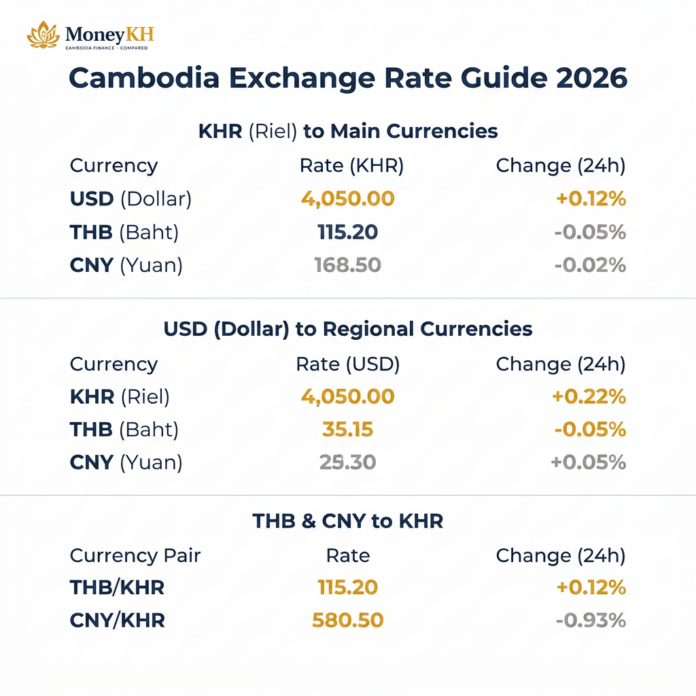
The rates below are mid-market reference rates as of April 2026. These are not transaction rates — they represent the mid-point between buy and sell, with no provider margin applied. Use these as your benchmark when comparing any exchange offer.
| Currency Pair | Mid-Market Rate (April 2026) | Direction | Primary Use in Cambodia |
|---|---|---|---|
| USD / KHR | 1 USD = ~4,100 KHR | KHR per USD | All daily transactions; primary currency pair for Cambodia commerce |
| THB / KHR | 1 THB = ~119 KHR | KHR per Thai Baht | Cross-border workers, western province trade, Thai tourism |
| CNY / KHR | 1 CNY = ~565 KHR | KHR per Chinese Yuan | Chinese business community, Cambodia-China trade, Sihanoukville |
| USD / THB | 1 USD = ~34.5 THB | THB per USD | Cambodians travelling to or working in Thailand; medical evacuation cost |
| EUR / USD | 1 EUR = ~1.08 USD | USD per Euro | European expats converting Euro pension/salary to USD for Cambodia banking |
| GBP / USD | 1 GBP = ~1.27 USD | USD per British Pound | British expats and retirees receiving GBP pension income |
| AUD / USD | 1 AUD = ~0.64 USD | USD per Australian Dollar | Australian expats and NGO workers |
| VND / KHR | 1 VND = ~0.163 KHR | KHR per Vietnamese Dong | Eastern province cross-border trade, Cambodian workers in Vietnam |
⚠️ Rates change daily. These are April 2026 reference figures. For live rates, check the NBC website, XE.com, or Wise’s rate display before any significant currency transaction.
Where to Exchange Currency in Cambodia — Your Options
1. Licensed money changers (best rate for cash exchange)
Licensed money changers in Phnom Penh — particularly those in Central Market (Psar Thmei), Russian Market, and the city centre — offer the most competitive rates for cash-to-cash exchange in Cambodia. They operate on thin margins and high volume. USD to KHR and KHR to USD are their core products. For THB, CNY, and major Western currencies, rates are also competitive but vary more between changers — shop around.
Key rule: verify the licence. Licensed money changers in Cambodia must display their NBC licence. Unlicensed operators exist particularly in tourist areas and offer less protection if a dispute arises. The rate difference between licensed and unlicensed operators is often negligible — the licence is about protection, not price.
2. Commercial banks (safe, regulated, slightly lower rates)
ABA Bank, ACLEDA, Canadia Bank, and other commercial banks offer currency exchange at their branches. Rates are regulated, fully transparent, and the transaction is legally protected. Bank exchange rates are typically 0.5–1.5% less favourable than licensed money changers for spot cash exchange — a meaningful difference on large amounts, trivial on small ones. Banks are the right channel for large transactions where security and documentation matter.
3. Airport exchange counters (worst rates — avoid for large amounts)
Phnom Penh International Airport exchange counters offer the least competitive rates in Cambodia — typically 3–5% below mid-market. Exchange only what you need for immediate transport on arrival. Get your main cash from a city money changer or ATM after clearing customs.
4. Hotel exchange (avoid)
Hotels that offer currency exchange typically apply rates 3–7% below mid-market. Never exchange significant amounts at a hotel front desk if a money changer or bank branch is accessible nearby.
Bank Rate vs Money Changer Rate — Understanding the Difference
The difference between the mid-market rate (what you see on XE.com or Wise) and what any provider offers you is called the spread. This spread is how banks and money changers make their profit on currency exchange. Understanding spreads lets you calculate the real cost of any exchange.
How to calculate what you’re actually paying:
- Find the mid-market rate for your currency pair (XE.com or Wise)
- Note the rate the provider offers you (their sell rate for the currency you are buying)
- Calculate the percentage difference: ((mid-market – provider rate) / mid-market) × 100
- This percentage is the cost of your exchange, expressed as a fee
Worked example — USD to KHR:
Mid-market rate: 4,100 KHR/USD
Money changer offers: 4,075 KHR/USD
Spread: (4,100 – 4,075) / 4,100 = 0.6% — reasonable
On $1,000 exchanged, you receive ₭4,075,000 instead of ₭4,100,000 — difference: ₭25,000 (~$6.10)
Typical spreads in Cambodia (April 2026):
| Provider Type | USD/KHR Spread | USD/THB Spread | EUR/USD Spread |
|---|---|---|---|
| Licensed money changer (Phnom Penh) | 0.3–0.8% | 0.5–1.5% | 1.0–2.0% |
| Commercial bank branch | 0.5–1.5% | 1.0–2.0% | 1.5–2.5% |
| ATM (foreign card) | 2.0–4.0% + flat fee | N/A (USD only at most ATMs) | N/A |
| Airport exchange | 3.0–5.0% | 3.0–6.0% | 3.0–6.0% |
| Wise (digital transfer) | 0.4–0.8% | 0.4–0.9% | 0.4–0.7% |
ATM Exchange Rates — The Real Cost in Cambodia
Using a foreign debit or credit card at a Cambodia ATM involves multiple layers of cost that many travellers underestimate:
- ATM operator fee: Cambodia ATMs charge a local fee per withdrawal — typically $4–$6 per transaction. ABA Bank’s ATMs charge $5 for foreign card withdrawals. This is a flat fee regardless of withdrawal amount.
- Home bank international fee: Your home bank typically charges 1–3% of the withdrawal amount as an international transaction fee.
- Exchange rate margin: The conversion from KHR or USD at the ATM to your home currency applies a rate 2–4% below mid-market.
- Dynamic Currency Conversion (DCC) trap: Some Cambodia ATMs offer to convert your withdrawal to your home currency at the point of transaction — “do you want to pay in USD or GBP?” Always choose the local currency (USD or KHR) — the ATM’s conversion rate for DCC is typically 5–8% below mid-market, far worse than your home bank’s rate.
The practical rule: For foreign card ATM withdrawals in Cambodia, always choose USD, withdraw larger amounts less frequently (to dilute the flat fee), and use a home bank account with no international withdrawal fees if possible. For the full fee comparison of Cambodia ATMs by bank, see our Cambodia ATM fees guide.
Using Wise for Currency Exchange in Cambodia
Wise (formerly TransferWise) offers mid-market exchange rates with a small transparent fee — typically the most cost-effective option for converting significant amounts of foreign currency into USD for deposit in a Cambodia bank account. For European expats converting EUR or GBP pension income, and for digital nomads converting client payments from non-USD currencies, Wise’s rate advantage over bank and money changer rates compounds meaningfully over time.
How it works for Cambodia: Convert in Wise (EUR → USD, GBP → USD, etc.) and send the USD to your ABA Bank account via SWIFT. The Wise rate is near mid-market with a transparent 0.4–0.8% fee. Compare this to a bank’s 1.5–2.5% spread on the same conversion — on a €1,000 monthly pension, the annual saving is approximately $130–$200 USD.
For the full review of Wise’s Cambodia functionality — including what works, what doesn’t, and current transfer limits — see our Wise Cambodia review. For a full comparison of all money transfer options to Cambodia, see our best ways to send money to Cambodia guide.
Common Currency Pairs — Cambodia-Specific Context
THB (Thai Baht) — the most important regional currency for Cambodia
Thailand is Cambodia’s largest trading partner and the most common destination for Cambodian labour migration. Hundreds of thousands of Cambodians work in Thai construction, agriculture, fishing, and manufacturing — and send THB remittances home monthly. The THB/KHR and THB/USD rates directly affect the real income of these workers and their Cambodian families. For money transfer from Thailand to Cambodia, see our send money Thailand to Cambodia guide.
CNY (Chinese Yuan/Renminbi) — growing importance
China is Cambodia’s largest foreign investor and a major trading partner. The Chinese business community in Cambodia — particularly in Phnom Penh, Sihanoukville, and border areas — conducts significant business in CNY alongside USD. CNY exchange is available at major Phnom Penh money changers and some commercial bank branches. NBC has facilitated CNY settlement mechanisms through the Bakong system — see our Bakong complete guide for details on the NBC-PBoC payment linkage.
VND (Vietnamese Dong)
Vietnam shares Cambodia’s eastern border and is an important trading and tourism corridor. VND is exchangeable at border crossings (Bavet, Kampong Cham) and some Phnom Penh money changers. Rates are less competitive than USD/KHR — VND is a lower-volume currency for Cambodia changers. For cross-border money transfers to Vietnam, see our sending money from Cambodia internationally guide.
KRW (Korean Won)
South Korea is Cambodia’s fourth-largest source of foreign investment and the garment industry’s second-largest export market. Significant numbers of Cambodians work in Korea under the Employment Permit System and send KRW remittances home. For money transfer from Korea to Cambodia, see our send money Korea to Cambodia guide.
Exchange Rates for Businesses Operating in Cambodia
Businesses operating in Cambodia face exchange rate considerations that go beyond personal travel — particularly those with multi-currency revenue streams, international supplier payments, or cross-border payroll.
USD functional currency is the practical choice for most businesses. Most commercial contracts, property leases, and supplier invoices in Cambodia are denominated in USD. Operating with USD as your functional currency eliminates KHR conversion steps for the majority of transactions and aligns with Cambodia’s effective dollarisation. For formal accounting purposes, the NBC publishes official daily exchange rates used for statutory KHR reporting.
FX risk management for Cambodia businesses:
Businesses with significant non-USD revenue — CNY from Chinese clients, THB from Thai customers, EUR from European NGO funders — face genuine FX conversion risk. Commercial banks in Cambodia offer basic FX hedging products (forward contracts) for businesses with predictable foreign currency cash flows. ABA Bank and Maybank Cambodia are the most accessible options for business FX services — Maybank particularly so for businesses with ASEAN cross-border flows given its regional treasury capabilities.
Payroll in multi-currency businesses:
Businesses with both Cambodian and expatriate staff frequently pay local staff in KHR or USD and expat staff in their home currencies. Payroll FX conversion should be done at commercial bank rates or better — using Wise for business payments is permitted and cost-effective for smaller international payroll flows. For business banking setup in Cambodia including corporate bank account opening, see our Cambodia business registration and banking guide.
Frequently Asked Questions — Cambodia Exchange Rates 2026
What is the exchange rate from USD to KHR in Cambodia in 2026?
The mid-market rate in April 2026 is approximately 4,100 KHR per USD. The NBC maintains a managed float keeping the rate broadly stable in the 4,000–4,200 range. Licensed money changers typically offer 4,060–4,085 KHR per USD for cash exchange. Banks offer slightly less. For live rates, check the NBC website or XE.com.
Where is the best place to exchange currency in Cambodia?
For cash-to-cash exchange: licensed money changers in Phnom Penh’s central markets (Central Market, Russian Market) offer the most competitive rates. For digital transfers: Wise offers near-mid-market rates for converting foreign currencies into USD before depositing in a Cambodia bank account. Avoid airport exchange counters and hotel exchange desks — their rates are 3–7% below mid-market.
Can I use Thai Baht in Cambodia?
In border areas (Poipet, Koh Kong, Ha Tien corridor) THB is commonly accepted. In Phnom Penh and major cities, USD and KHR are the standard currencies — THB is not generally accepted by merchants. You should exchange THB to USD or KHR before travelling beyond border areas. Licensed money changers in Phnom Penh exchange THB at competitive rates.
Can I use Chinese Yuan (CNY) in Cambodia?
CNY is accepted in Chinese-operated businesses in Sihanoukville, Phnom Penh Chinatown, and border areas with Yunnan province — but it is not universally accepted like USD. For general use in Cambodia, convert CNY to USD at a licensed money changer. The NBC’s Bakong payment system has established a CNY settlement linkage with China’s payment infrastructure — relevant for business payments but not for retail cash transactions.
Does Cambodia have currency controls?
No. Cambodia has no significant foreign exchange controls — USD and KHR can be freely moved in and out of the country. There are declaration requirements for cash amounts above $10,000 USD when entering or leaving Cambodia (standard customs declaration). There are no restrictions on remittances or international transfers through commercial banks. This freedom of capital movement is one of Cambodia’s genuine financial advantages for expats and investors. For banking safety context, see our Is My Money Safe in a Cambodian Bank guide.
What is the official NBC exchange rate and how does it differ from the money changer rate?
The NBC publishes a daily official reference exchange rate for KHR against USD and other currencies. This rate is used for official reporting and statutory accounting purposes. Money changers and banks offer transaction rates that differ from the NBC reference rate by their operating margin — typically 0.3–2% depending on the provider and currency pair. The NBC rate is not a transaction rate — you cannot exchange currency at the NBC itself.
Should I bring USD cash to Cambodia or use my card?
For most visitors, a combination works best: bring USD cash for markets, tuk-tuks, and smaller vendors (where cards are not accepted), and use a card at ATMs and restaurants. If bringing cash from your home country, convert to USD before arrival — USD is universally accepted, while your home currency (GBP, EUR, AUD) may only be exchangeable at banks and selected money changers at less competitive rates. ATM withdrawals in Cambodia from a foreign card incur $4–$6 per transaction in operator fees — minimise withdrawal frequency by taking larger amounts. See our Cambodia ATM fees guide for full detail.
MoneyKH · Cambodia Personal Finance Authority Platform
Article 76 · Banking Category · April 2026
Editorial independence policy → · About MoneyKH →

The MoneyKH Research Team comprises independent financial researchers, market analysts, and editorial professionals with direct on-ground knowledge of Cambodia’s banking, fintech, and financial services sector. All rates, fees, and product data published on MoneyKH are verified directly with each institution before publication. MoneyKH operates as an editorially independent platform with no affiliate partnerships — see our editorial policy for full disclosure.